

Why More Technology Won’t Fix Your Sales Growth Problem
Over the past decade, sales organizations have invested heavily in growth strategies, new sales methodologies, advanced technology platforms, analytics tools, and redesigned processes. The promise was simple: better systems would create better results.
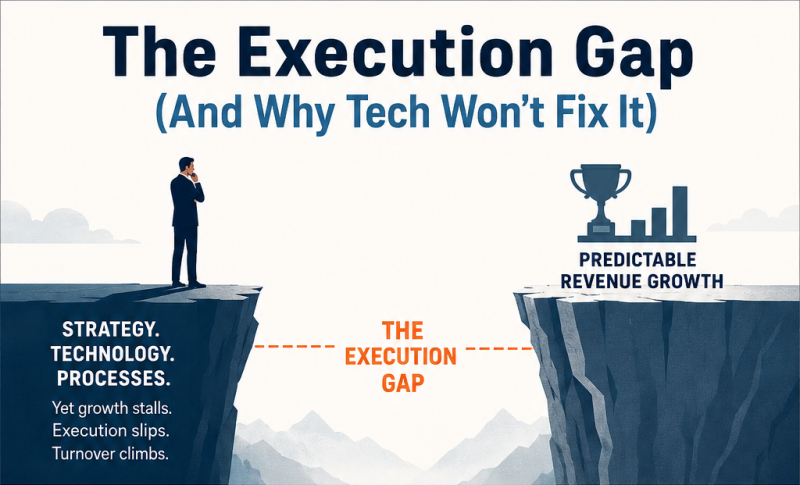
Yet many organizations are experiencing a frustrating reality. Growth remains inconsistent. Execution slows down. Teams become overwhelmed. High performers burn out. Turnover increases. The challenge is not a lack of effort. It is not a shortage of technology. And in many cases, it is not even a problem with the sales team's ability to sell.
The real constraint is something deeper: A leadership execution gap.
#1. The Hidden Bottleneck Behind Stalled Growth
Most organizations assume that if they provide their teams with the right strategy, tools, and processes, performance will naturally improve. But strategy only creates potential. Technology only creates capability. Processes only create structure. Someone still has to make it all work. That responsibility falls on today’s sales leaders.
Modern sales leaders are no longer simply responsible for hitting a number. They are expected to coach high-performing teams, develop talent, interpret complex data, manage organizational change, reinforce culture, and navigate unpredictable markets-all while delivering consistent revenue growth. The role has fundamentally changed. The problem is that many organizations are still developing these leaders using an outdated model.
#2. The Old Leadership Development Model Is Broken
The traditional path to sales leadership often looks like this:
* Identify your top salesperson.
* Promote them into management.
* Send them to a leadership workshop.
* Provide a few resources.
* Expect them to figure out the rest.
This approach worked when leadership was primarily about managing activity and overseeing results. Today, it is not enough. A great salesperson does not automatically become a great sales leader. The skills that create individual success are often different from the skills required to scale a team. Leading requires a different operating system.
It requires the ability to coach instead of simply direct. To diagnose instead of react. To create accountability instead of relying on personal effort. To build systems that allow others to succeed. Without those capabilities, even talented leaders can become trapped in the daily firefighting cycle.
#3. Why One-Time Training Doesn’t Create Lasting Change
Leadership development is often treated as an event. A workshop. A conference. A two-day retreat.
These experiences can create awareness and inspiration, but awareness alone does not create transformation. Real leadership growth requires repetition. It requires:
* Continuous coaching and feedback
* Reflection on real business challenges
* Objective accountability
* Practical problem-solving
* Reinforcement over time
The gap between knowing what to do and consistently doing it is where many organizations struggle. A leader may understand the importance of coaching—but still spend every week buried in forecasting, escalations, internal meetings, and urgent customer issues. Without an ongoing strategic sounding board, even the best leadership ideas get consumed by operational pressure.
#4. The Shift: Leadership Development as Business Infrastructure
High-performing organizations are beginning to rethink how they build leaders. They are moving away from occasional training programs and toward embedded leadership support. They recognize that leadership capability is not a nice-to-have initiative. It is part of the infrastructure required to scale. This is where a Fractional Growth Partner can create significant impact.
#5. What Is a Fractional Growth Partner?
A Fractional Growth Partner provides experienced strategic guidance without requiring a full-time executive investment. They work alongside leadership teams to help transform potential into consistent execution. A strong fractional partner helps leaders:
* Translate strategy into measurable action
* Build repeatable sales systems
* Strengthen coaching capabilities
* Improve accountability rhythms
* Identify execution barriers
* Create alignment across teams
* Drive predictable revenue growth
The value is not simply advice. The value is having an experienced partner who helps leaders think clearly, challenge assumptions, and solve problems in real time.
#6. The Companies That Scale Are Building Better Leaders
The organizations that outperform their competitors are not relying on hope. They are not assuming their managers will naturally evolve as the business grows. They are intentionally investing in the leadership capabilities required for the next stage of growth. Because technology will continue to change. Markets will continue to shift. Strategies will continue to evolve. But execution will always depend on people. And people perform at the level of leadership they experience every day.
Closing the execution gap is not about adding another tool, another process, or another training session. It is about building leaders who can turn strategy into action-and action into predictable results.
Written by Gerald Garcia
Add comment
Comments