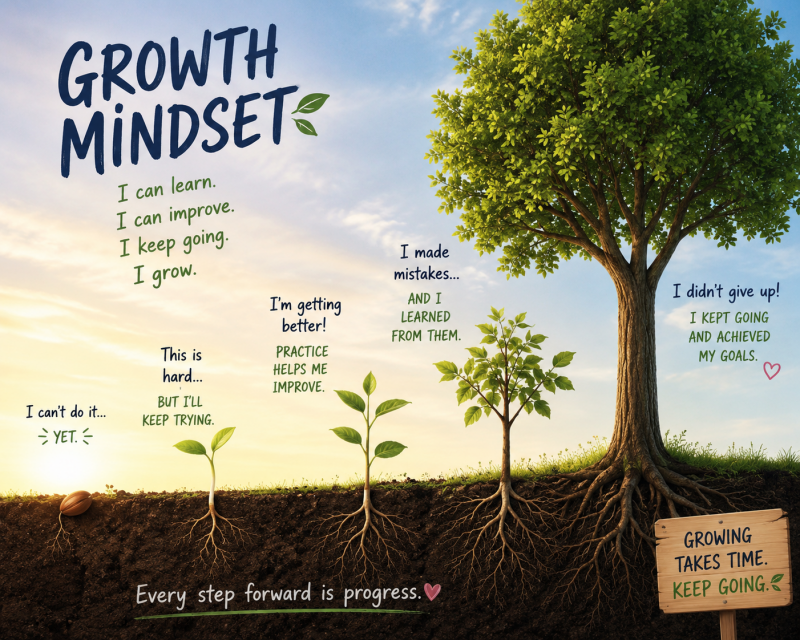
Growth Mindset is an international context
Lean Doesn’t Mean Retreat: How Smart Companies Grow in Uncertain Markets
Why mindset determines whether global ambition turns into sustainable growth (or quiet stagnation).
When leaders talk about international expansion, the conversation usually centres on strategy, structure, and hiring. Market entry plans. New products. Local partners. All of these are important, but rarely decisive on their own.
In the current environment - marked by energy volatility, cost pressure, and geopolitical uncertainty - many leadership teams are shifting into defensive mode. Budgets are tightening. Expansion plans are being paused or scaled back. This is understandable. But it’s also where many organisations make a critical mistake: confusing cost discipline with strategic withdrawal.
What I see consistently - especially in organisations operating across borders - is that the real constraint on growth is mindset. Not in the abstract, motivational sense, but in how leaders and teams respond to uncertainty, feedback, and failure when the stakes are high.
In a recent piece, Growth vs Stagnation, I explored what happens when organisations harden their thinking and stop listening - to customers, to their people, and to the market. A growth mindset is the counterweight. It’s what allows international ambition to stay adaptive rather than defensive. This article looks at growth mindset not as a cultural slogan, but as a practical growth lever for organisations scaling into new markets - especially when operating lean.
Growth Mindset in an International Context
The concept of a growth mindset, introduced by Dr Carol Dweck, is often reduced to a simple idea: abilities can be developed through learning and effort. That’s true, but incomplete. In constrained environments, a growth mindset is not about optimism. It’s about resourcefulness - how effectively a team can learn, adapt, and generate results with limited time, budget, and certainty.
In international environments, this shows up very practically in how teams handle:
- New and unfamiliar customer expectations
- Different cultural norms around communication and decision-making
- Longer feedback loops and higher levels of ambiguity
A fixed mindset seeks certainty before action. A growth mindset accepts learning as part of the work.
The question is not whether to operate lean. Most organisations have to. The real question is:
Do you become lean and adaptive - or lean and inactive?
One drives efficiency and learning. The other leads to stagnation disguised as prudence.
Learning Under Constraint: A Case in Motion
During an early international engagement, I was tasked with opening a new region for a major SaaS/data infrastructure client. The mandate was simple but daunting:
Generate qualified pipeline in a market where you had no historical data, no established messaging, and no clarity on how CIO/CTO buyers made decisions. The client wanted certainty - predictable conversion, validated messaging, and a clear playbook - but none of that existed yet.
At the same time, there was no appetite for waste. No room for slow, expensive trial-and-error. The only viable path was disciplined experimentation over perfect planning.
Three layers of ambiguity quickly emerged:
- New and unfamiliar customer expectations
European CIOs expected deeper technical validation, longer discovery cycles, and multi-stakeholder consensus. APAC-tested messaging didn’t land. - Different cultural norms around communication
Direct outreach that worked in Australia felt too forward in Germany and Switzerland. Buyers preferred a slower, credibility-building approach. - Longer feedback loops
Where APAC prospects responded within days, EMEA cycles stretched to weeks. Fast iteration wasn’t possible.
A fixed mindset would have stalled:
“We need more certainty before we act.”
But progress was required - without increasing cost or complexity. So I took three decisive steps:
- Ran rapid micro-experiments across markets
- Built a cultural intelligence loop
Engaged local partners, analysed buyer responses, and adapted messaging from feature-led to risk and compliance-led. - Re-educate the client
Reset expectations around velocity, conversion, and stakeholder engagement for EMEA markets.
Within six weeks:
- We generate consistent SQL flow in a previously underperforming region
- Establish a repeatable, culturally aligned playbook
- Position ourselves as a strategic advisor - not just an execution partner
No additional budget, just faster learning.
Where Growth Mindset Shows Up in Real Business Outcomes
1. Sales and Market Learning
International sales environments expose assumptions quickly. In uncertain markets, the biggest risk is often premature withdrawal.
Teams operating with a fixed mindset interpret slow traction as proof that:
- “This market doesn’t work”
- “We’re not suited to this region”
The response is withdrawal or blame.
Teams with a growth mindset ask different questions:
- What are we missing about how buyers here make decisions?
- Where does our value proposition need translation, not dilution?
- What can this loss teach us about the next opportunity?
Over time, this learning compounds. Sales capability improves not through confidence alone, but through adaptation. And we need to keep trying, tweak different ways until we find the right fit for the right audience at the right time
2. Customer Engagement Across Cultures
Customer expectations are not universal. A fixed mindset defaults to policy, script, or precedent:
“This is how we do it.”
A growth mindset stays curious:
- How does trust get built in this market?
- Where do we need flexibility versus consistency?
- What is this customer actually optimising for?
In international settings, this curiosity is not a “nice to have.” It’s what turns early friction into long-term loyalty. In one engagement with a European company expanding into APAC, our standard fast-paced sales approach failed immediately.
The client:
- Wanted more documentation before meetings
- Preferred formal written communication
- Required multi-stakeholder alignment early
- Was uncomfortable with speed and informality
A fixed response would have labelled them “difficult.” Instead, we recognised they were protecting trust.
We adapted:
- Slowed the cadence
- Shifted to structured, compliance-first communication
- Mapped internal decision-making
- Reframed the value proposition around risk and governance
Within weeks:
- The relationship became collaborative
- We were invited into internal planning
- Scope expanded significantly
The product didn’t change. The mindset did.
3. Team Trust and Psychological Safety
International growth puts pressure on teams. Different time zones, communication styles, and expectations increase the likelihood of misunderstanding. Without psychological safety, teams retreat into silos. In one global sales program spanning APAC and EMEA, misalignment triggered client escalation.
A fixed mindset would have treated it as a performance issue.
Instead, we treated it as a learning signal. We:
- Named uncertainty openly
- Shared insights across regions
- Normalised course correction
- Created space for questions and experimentation
- Identify key stakeholder in the region and empower them
Within a month:
- Alignment improved
- SQL quality increased
- Collaboration strengthened
- Teams raised issues earlier
The result wasn’t chaos. It was trust.
Embedding Growth Mindset into the Operating Rhythm
You can’t mandate a growth mindset. But you can design for it. In organisations scaling internationally, this shows up through:
- Language
Debriefs focused on learning, not just outcomes - Signals
Recognition of adaptation, not just success - Framing
In tighter economic conditions, these behaviours become even more critical.
You don’t have the luxury of:
- slow feedback loops
- wasted cycles
- rigid thinking
Growth mindset, in this context, enables organisations to:
- test faster
- learn cheaper
- avoid large, expensive missteps
From Mindset to Momentum
In periods of economic pressure, the instinct is often to slow down. But in international markets, momentum is rarely regained easily once lost. A growth mindset doesn’t replace strategy. It enables it.
The organisations that outperform in volatile conditions are not the ones that spend the most.
They are the ones that:
- learn the fastest
- adapt the quickest
- stay engaged while others pull back
At the Meridian Exchange, we work with leadership teams to translate ambition into execution - making mindset, capability, and alignment visible so teams can see where growth is being enabled, and where fixed thinking is quietly slowing progress. International growth isn’t just about entering new markets. It’s about building teams that can learn their way forward—efficiently, intelligently, and without retreating when conditions tighten.
Final takeaway:
In uncertain markets, growth doesn’t come from doing more.
It comes from learning better than your competitors while they hesitate.